
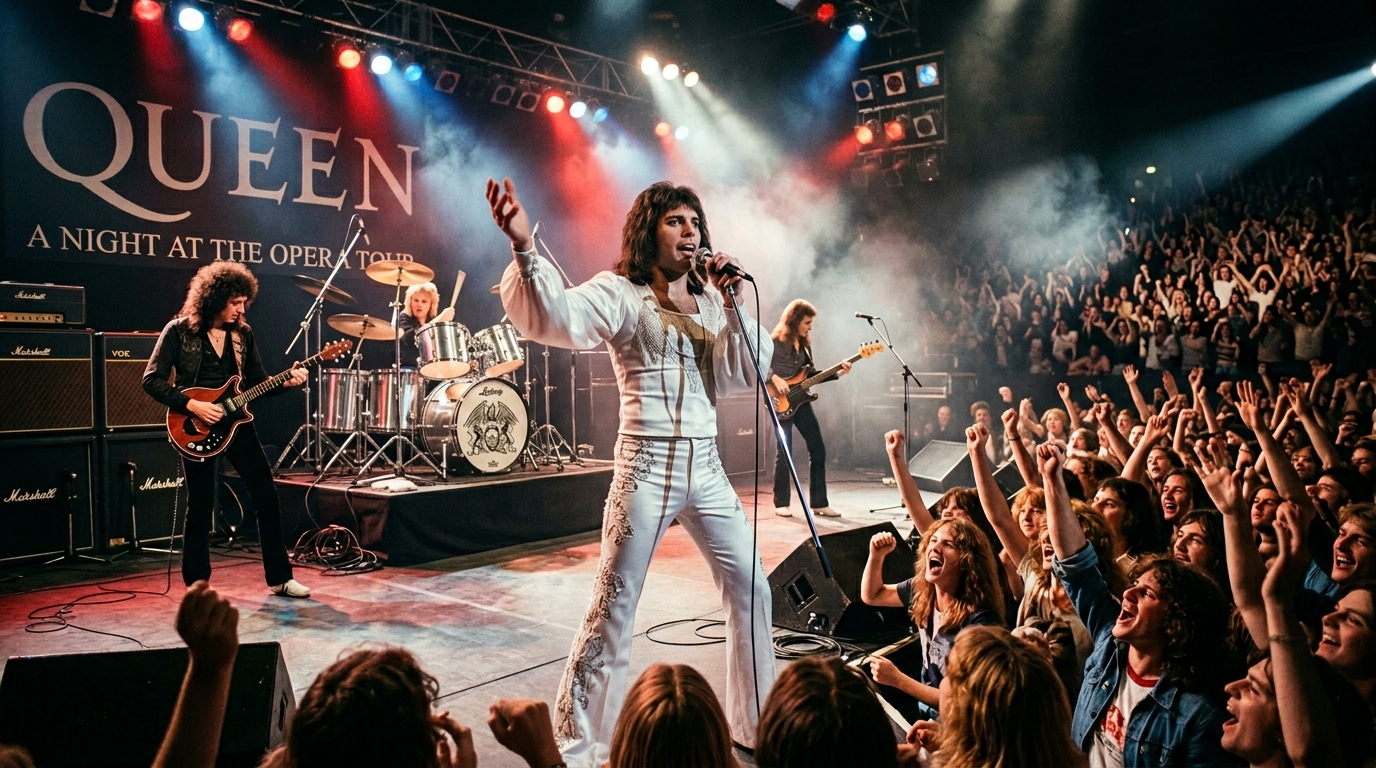
The search for lirik We Are the Champions remains popular worldwide because Queen’s legendary song continues to inspire generations. Written by Freddie Mercury and released in 1977, the track became a universal anthem of victory, perseverance, and success. This guide explores the song’s meaning, history, cultural impact, and the story behind one of rock music’s greatest masterpieces.
Quick Bio: Freddie Mercury and Queen
| Detail | Information |
|---|---|
| Artist / Band | Queen |
| Lead Singer | Freddie Mercury |
| Real Name | Farrokh Bomi Bulsara |
| Born | September 5, 1946, Stone Town, Zanzibar, Tanzania |
| Died | November 24, 1991, London, England (Age 45) |
| Nationality | British |
| Band Formed | 1970, London, England |
| Band Members | Freddie Mercury, Brian May, Roger Taylor, John Deacon |
| Song | We Are the Champions |
| Album | News of the World |
| Released | October 1977 |
| Written By | Freddie Mercury |
| Genre | Classic Rock, Arena Rock |
| Famous For | Bohemian Rhapsody, We Will Rock You, Somebody to Love, We Are the Champions |
| Vocal Range | Four-octave range |
| Legacy | Ranked among greatest rock singers of all time |
About the Song We Are the Champions
We Are the Champions is one of the most recognizable and emotionally powerful rock songs ever created. Written and performed by the British rock band Queen, the song was released in October 1977 as part of their sixth studio album News of the World. It was written entirely by lead singer and pianist Freddie Mercury and quickly became not just a hit single but a permanent anthem of victory, resilience, and collective triumph.
The song’s lirik (lyrics) speak directly to the human experience of overcoming hardship, facing judgment, and ultimately rising above challenges to claim success. From the very first line, Mercury draws the listener into a personal narrative of struggle and eventual triumph that resonates across cultures, languages, and generations.
In many parts of Southeast Asia including Indonesia and Malaysia, the word lirik is used to describe song lyrics, which explains the widespread search for lirik We Are the Champions across the region. The song transcends language barriers because its emotional core is universal.
The Story Behind Writing We Are the Champions
The inspiration behind We Are the Champions came from a real experience that Queen had during a concert. While performing in Bingley Hall, Stafford in England, the crowd spontaneously began chanting a popular football anthem called You Will Never Walk Alone after Queen finished their set. The crowd’s energy and collective voice left a profound impression on Freddie Mercury.
Mercury was deeply moved by how an entire arena of thousands of people could unite behind a single chant. He wanted to capture that same energy and write a song that audiences could own collectively. He has described wanting the we in the song to mean everyone who sings it, not just Queen as a band.
At the same time, Mercury drew from Queen’s own real-life journey. The band had struggled for years before achieving mainstream success. They had faced criticism from music press, financial difficulties, and industry skepticism. The lirik of the song reflects those real struggles expressed through deeply personal imagery.
This same experience also inspired We Will Rock You, written by guitarist Brian May, which was released on the same single as the B-side. The two songs became an inseparable pair, one building anticipation and the other delivering victory.
Complete Lirik We Are the Champions with Meaning
The lirik We Are the Champions tells a story in three distinct emotional movements. It begins with personal hardship, builds through perseverance, and arrives at triumphant collective celebration.
The song opens with Mercury acknowledging that he has paid dues and served his time. He admits to making mistakes but insists he has committed no crimes worthy of punishment. This sets up a narrative of a person who has suffered unfairly but endured with dignity.
The chorus then erupts with pure defiance and celebration. The declaration that we are the champions transforms a personal struggle into a collective victory. By using the word we, Mercury makes every listener a participant in the triumph rather than just a witness to it.
The second verse deepens the reflection. Mercury describes receiving bows and curtain calls from the audience, which suggests fame and recognition arriving after years of hard work. He mentions sand kicked in his face as a metaphor for humiliation endured on the road to success.
The song then closes without resolution in a conventional musical sense. The final note famously ends without a complete chord resolution, leaving the listener suspended in triumph. Musicologists have noted this as one of the most unusual endings in rock history.
Verse One and Its Deep Message
The opening verse of We Are the Champions is among the most quietly powerful in all of rock music. Mercury begins with the phrase that he has paid his dues time after time. This line communicates a lifetime of effort, repetition, and sacrifice that most people never see from the outside.
He follows by acknowledging that he has done his sentence but committed no crime. This is a powerful statement about the injustice that talented people sometimes face. It suggests that suffering and struggle can come even to those who have done nothing wrong, and that endurance rather than guilt defines the outcome.
By describing mistakes as part of the experience without shame or excuse, Mercury creates a protagonist who is honest, grounded, and deeply human. This is what makes the lirik so universally relatable. Every person who has faced failure, criticism, or unfair treatment can hear themselves in these words.
The Pre-Chorus and What It Represents
The pre-chorus section of the song introduces another layer of emotional complexity. Mercury sings about being treated poorly by others, facing challenges head-on, and being hit hard while continuing forward.
This section is written in the first person singular but carries a communal weight. The experiences described are not unique to Mercury or Queen. They are the shared experiences of anyone who has pursued a dream in the face of opposition. The lirik here speaks to athletes facing defeat, artists facing rejection, workers facing setbacks, and individuals facing personal crises.
The pre-chorus builds musically toward the chorus with deliberate tension. The key shifts from D major toward Bb major creating a sense of rising emotion that makes the eventual chorus feel like a genuine emotional release rather than just a lyrical statement.
The Iconic Chorus Explained
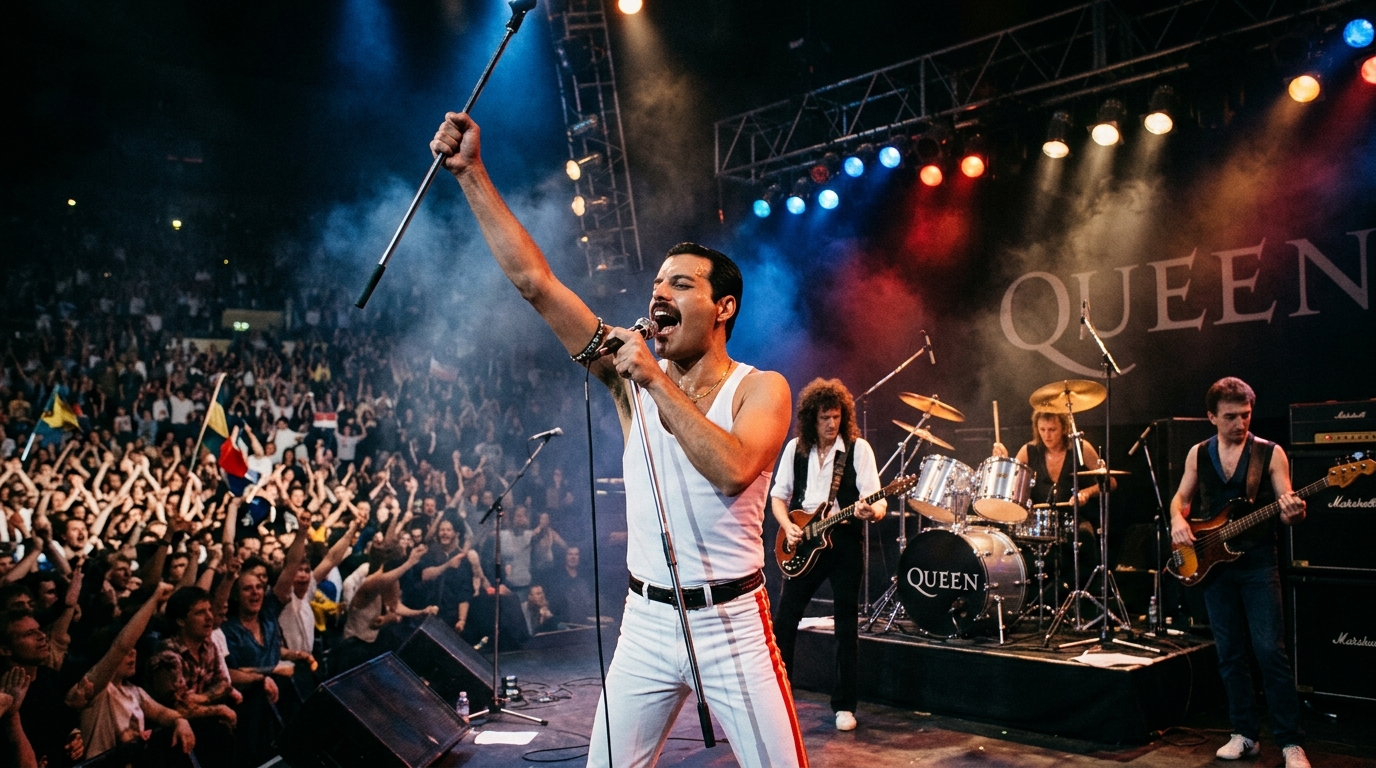
The chorus of We Are the Champions is one of the most famous in musical history. The declaration is simple, direct, and absolute. There are no qualifiers, no doubts, and no hesitation. The use of the plural we is the most important word in the entire song.
Freddie Mercury has explained that when he wrote we, he intended it to include every person who sings the song. This was not Queen declaring themselves champions above others. It was Mercury inviting the entire audience, and by extension the entire world, to claim victory alongside the band.
The line that follows, stating there is no time for losers because we are the champions, has been interpreted in two very different ways. Some hear it as arrogant dismissal of those who fail. Others hear it as a focused declaration that champions cannot afford to dwell on defeat or negativity. Mercury himself suggested the latter interpretation, saying the song was ultimately about resilience and forward momentum rather than contempt for others.
Verse Two and the Journey of Struggle
The second verse of the lirik We Are the Champions shifts into the language of achievement and recognition. Mercury describes taking bows and curtain calls, experiencing fame, and receiving the adulation of crowds. He then contrasts this with the image of having sand kicked in his face.
This contrast is deliberate and musically brilliant. By placing the image of humiliation inside a verse that otherwise describes success, Mercury acknowledges that victory never fully erases past struggles. The memory of being knocked down remains even when one is standing at the top. lirik we are the champion.
The reference to fame and fortune coming with the title of champion is honest rather than boastful. Mercury is not pretending that success came easily or that it arrived without cost. Instead he is celebrating that the cost was ultimately worth paying.
Musical Structure of We Are the Champions
We Are the Champions is composed primarily in the key of D major with a notable shift to Bb major during the pre-chorus section. This key change is a sophisticated compositional technique that creates emotional contrast and prepares the listener for the emotional peak of the chorus.
The harmonic structure uses familiar chord progressions in the verses, creating a sense of steady forward motion that mirrors the lyrical theme of perseverance. The pre-chorus progression introduces tension that makes the return to D major in the chorus feel like an arrival rather than just a repetition. lirik we are the champion.
Perhaps the most famous musical detail of the song is its unconventional ending. The final chord does not resolve in the way listeners expect from classical harmonic structure. This unresolved ending has been interpreted by music theorists as a deliberate choice that mirrors the message of the song itself. Champions do not stop. There is no final resolution because the journey of a champion never truly ends.
Freddie Mercury’s Vocal Performance
Freddie Mercury’s voice on We Are the Champions demonstrates all the qualities that made him one of the greatest rock vocalists in history. His certified four-octave vocal range is deployed strategically throughout the song, moving from intimate lower register tones in the verses to powerful high notes in the chorus.
The opening lines are delivered with controlled restraint that suggests personal reflection rather than public declaration. As the song builds through the pre-chorus, Mercury’s voice gains intensity and urgency. By the time the chorus arrives, his delivery has transformed into something that feels less like singing and more like an announcement of immutable truth. lirik we are the champion.
Live performances of the song, including the legendary Live Aid concert at Wembley Stadium in 1985, showed that Mercury’s ability to command tens of thousands of people with his voice was unmatched in the rock era. The song became one of the centerpieces of Queen’s live show precisely because of how dramatically it could unite an arena audience.
Why We Are the Champions Became a Sports Anthem
Few songs in history have achieved the status of universal sports anthem the way We Are the Champions has. From the FIFA World Cup to the Super Bowl, from Olympic celebrations to local sports team victories, this song has accompanied sporting triumph on every continent. lirik we are the champion.
The reason for its adoption by the sports world is deeply rooted in the lirik itself. The song’s imagery of struggle, perseverance, and ultimate victory maps perfectly onto athletic competition. Every athlete who trains for years, faces defeat, and finally wins can find their story in Mercury’s words.
The song was officially used as the theme of the 1994 FIFA World Cup, cementing its status as the defining musical expression of sporting achievement. Its use at the Super Bowl, the NFL playoffs, and countless other sporting events has only reinforced this identity over the decades.
We Are the Champions at Live Aid 1985
The most celebrated live performance of We Are the Champions took place at the Live Aid concert held at Wembley Stadium in London on July 13, 1985. Queen’s 21-minute set at this historic charity concert is widely regarded as the greatest live rock performance in history.
When Mercury launched into the opening lines of We Are the Champions near the end of the set, the 72,000 people in the stadium and the estimated 1.9 billion television viewers worldwide experienced the song in its most complete and overwhelming context. The song transformed from a stadium anthem into a genuine moment of global unity. lirik we are the champion.
The Live Aid performance introduced lirik We Are the Champions to an entirely new generation of listeners worldwide, including millions in Asia who encountered Queen for the first time through that broadcast.
Cultural Impact Around the World
We Are the Champions has transcended its origins as a British rock song to become a genuinely global cultural artifact. It has been translated, covered, sampled, and adapted in dozens of languages and musical traditions across the world.
In Indonesia and Malaysia, where the search term lirik We Are the Champions generates enormous interest, the song holds particular significance in school sports events, national competitions, and celebrations of collective achievement. The word lirik in the search term reflects how deeply embedded this song has become in the musical consciousness of Southeast Asian audiences. lirik we are the champion.
The song has been covered by artists across genres ranging from classical orchestras to hip hop producers. Each interpretation discovers something new in the original lirik while preserving the essential emotional core that Mercury created in 1977.
We Are the Champions in Movies and Television
The cultural reach of We Are the Champions extends far beyond music into film and television. The song has appeared in hundreds of movies, television episodes, and commercial campaigns since its release.
Most notably, the 2018 biographical film Bohemian Rhapsody about Freddie Mercury and Queen used the song as a centrepiece of its climactic Live Aid sequence, introducing the song to an entirely new generation of global audiences. The film became one of the highest-grossing music biographical films in cinema history.
The song also appears regularly in comedies, dramas, and sports films as shorthand for the emotional experience of triumph. Its power to communicate victory instantly and without translation has made it one of the most efficiently used musical cues in entertainment history. lirik we are the champion.
Why Indonesians and Global Audiences Love This Song
The widespread search for lirik We Are the Champions from Indonesian and Southeast Asian audiences reflects a deep emotional connection to the song that transcends its Western rock origins. Indonesian music fans have a rich tradition of engaging with international songs through lirik searches, seeking to understand the full meaning behind the words they hear.
What resonates most for global audiences is that the lirik we are the champion of the song describes experiences that are not culturally specific. Paying dues, being knocked down, enduring criticism, and ultimately rising to claim a hard-won victory are human experiences that belong to every culture on earth.
The melody is also structured in a way that invites communal singing regardless of language fluency. Even listeners who do not speak English can participate in the chorus and feel the emotional meaning through the music itself.
The Legacy of We Are the Champions
Nearly five decades after its release, We Are the Champions remains as vital and emotionally resonant as it was in 1977. It is consistently ranked among the greatest rock songs ever recorded and is one of the most played songs in the history of radio worldwide.
The song outlived its creator. Freddie Mercury passed away on November 24, 1991, at the age of 45 due to complications from AIDS. But his voice, his words, and the collective triumph he encoded into the lirik of this song continue to move millions of people every year.
Queen as a band has continued performing with guest vocalists including Adam Lambert, bringing the song to new generations of live audiences. Each new stadium performance confirms that the emotional power Freddie Mercury placed inside those simple words has not dimmed in the slightest. lirik we are the champion.
Conclusion
Lirik We Are the Champions by Queen is far more than a set of words attached to a famous melody. It is a carefully crafted emotional journey from personal suffering through collective triumph that Freddie Mercury designed to belong to everyone who sings it. The song’s message of resilience, perseverance, and earned victory speaks to the deepest aspirations of human beings everywhere. Whether heard in a stadium, watched on a screen, or searched as lirik by fans across Indonesia and the world, these words carry the same power today that they delivered when Mercury first sang them to an arena of astonished fans in 1977. We are indeed the champions.
Frequently Asked Questions
Q1. What does lirik We Are the Champions mean?
Lirik is the Indonesian and Malay word for lyrics. Lirik We Are the Champions refers to the song lyrics of Queen’s famous 1977 anthem. The song’s lyrics describe overcoming hardship, facing challenges with courage, and ultimately achieving victory through perseverance.
Q2. Who wrote We Are the Champions?
We Are the Champions was written entirely by Freddie Mercury, the lead singer of Queen. He wrote it in 1977 and released it as part of the album News of the World. The song was inspired by football crowds and Queen’s own real-life journey to success.
Q3. When was We Are the Champions released?
The song was released in October 1977 as a single, with We Will Rock You on the B-side. Both songs were included on Queen’s sixth studio album News of the World, released on October 28, 1977.
Q4. Why did We Are the Champions become a sports anthem?
The song’s lyrics about struggle, perseverance, and ultimate victory mirror the emotional experience of athletic competition perfectly. Its use at major events including the 1994 FIFA World Cup and Super Bowl celebrations cemented its identity as the definitive musical expression of sporting achievement.
Q5. What does the we mean in We Are the Champions?
Freddie Mercury explained that he intended the word we to include everyone who sings the song, not just Queen. His goal was to make every listener feel like a champion, creating a collective experience of triumph rather than simply describing the band’s own success.